Industries today are looking for practical ways to reduce fuel expenses, manage agricultural waste and adopt more sustainable energy solutions. Biomass fuels have become an important option because they turn materials such as sawdust, rice husk, crop residues and other organic waste into useful sources of heat.
Among the most common options, biomass pellets and biomass briquettes are widely used in industrial heating systems, boilers and furnaces. Although both are produced by compressing biomass, they differ in size, manufacturing methods, handling requirements and suitability for different applications.
Understanding the difference between biomass pellet vs biomass briquette can help businesses select the right fuel for their equipment and production requirements. This guide explains their meanings, benefits, uses and the factors to consider when choosing between them.
What Are Biomass Pellets?
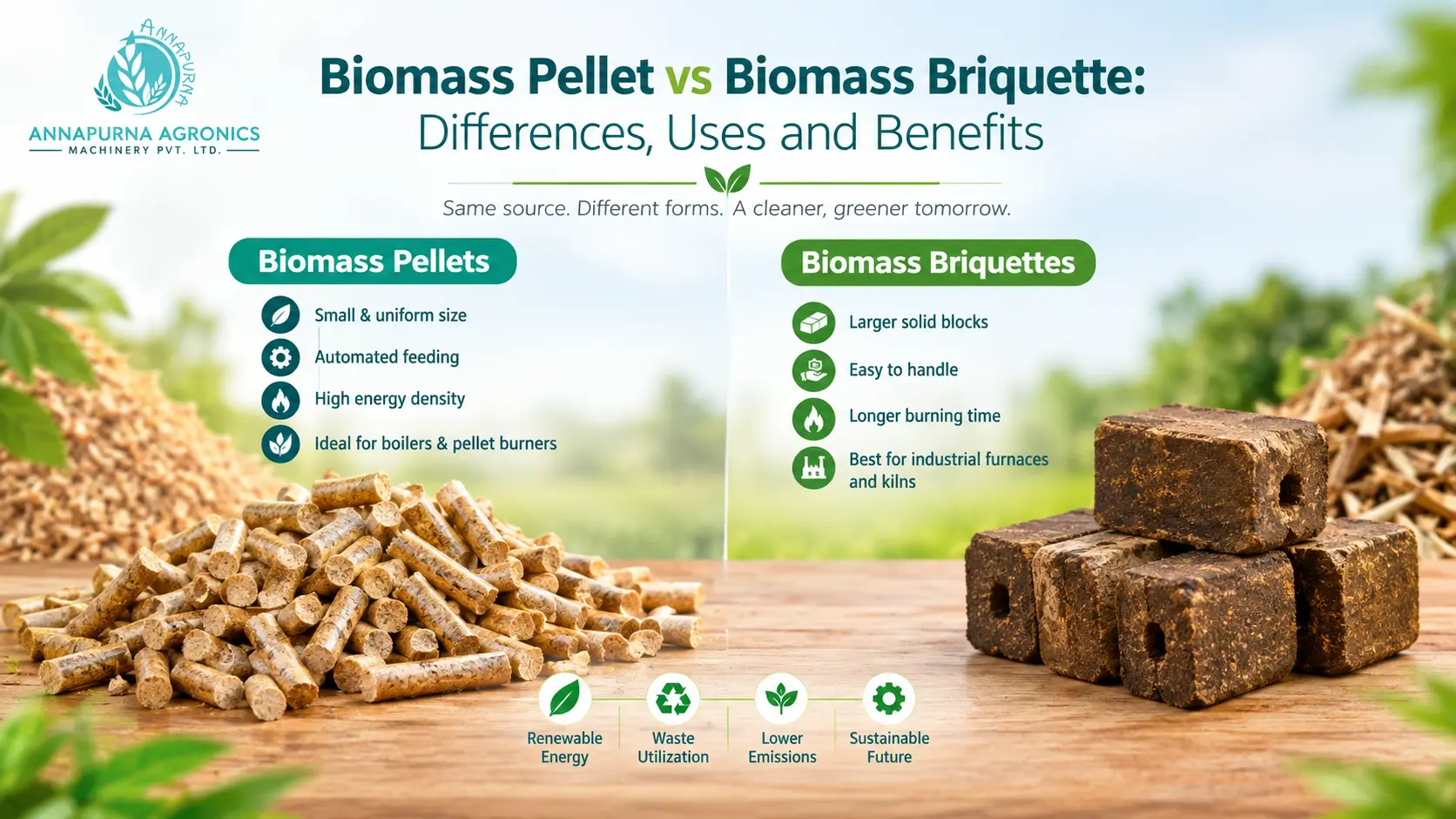
Biomass pellets are small, compact fuel units manufactured by compressing finely processed organic materials under pressure. They are generally cylindrical and uniform in size, making them suitable for applications that require controlled fuel feeding.
Common raw materials used to manufacture biomass pellets include sawdust, wood shavings, rice husk, agricultural residues, groundnut shells and other suitable biomass materials. The exact composition depends on the availability of raw materials and the quality requirements of the final product.
Also Read: What is Biomass Briquette? Types, Manufacturing Process & Benefits
Biomass Pellets Meaning and Manufacturing Process
The term biomass pellets meaning refers to small, densified fuel products made from organic materials that can be used for heat and energy generation. Pellet production generally involves the following steps:
- Raw material preparation: Agricultural or forestry waste is collected and sorted.
- Size reduction: The material is crushed or ground into suitable particles.
- Drying: Moisture is controlled to support effective pellet formation.
- Pelletizing: Processed biomass is compressed through a pellet mill to form small cylindrical units.
- Cooling and screening: Pellets are cooled, and loose particles or fines are separated.
- Packaging and storage: Finished pellets are stored in dry conditions to maintain their quality.
The final quality depends on raw material characteristics, moisture content, particle size, machine settings and processing conditions.
What Are Biomass Briquettes?
Biomass briquettes are solid fuel blocks produced by compressing agricultural waste, sawdust and other suitable organic residues. Compared with pellets, briquettes are considerably larger and may be cylindrical, rectangular or hexagonal, depending on the machine and mould design.
They are commonly used in industrial boilers, furnaces, brick kilns and other heating systems that can accommodate larger fuel pieces. Biomass briquettes can also provide a practical way to convert loose agricultural residues into a more manageable fuel.
How Are Biomass Briquettes Manufactured?
The briquetting process starts with collecting and preparing suitable biomass materials. Depending on the raw material, the process may include drying, crushing, screening and feeding the prepared material into a briquetting machine.
The machine applies pressure to form compact briquettes. In many systems, the natural binding properties of biomass help hold the material together without additional binders. However, the exact process depends on the feedstock and equipment design.
After compression, the briquettes are cooled or conditioned as required before storage and transportation. Proper moisture control and handling help maintain their strength and combustion performance.
Biomass Pellet vs Biomass Briquette: Key Differences
Both fuels use biomass resources, but their physical characteristics and operating requirements are different.
| Comparison factor | Biomass Pellets | Biomass Briquettes |
|---|---|---|
| Size and shape | Small, uniform cylindrical pieces | Larger blocks, rods or shaped pieces |
| Raw material | Usually finely ground biomass | Prepared biomass, which may have a coarser particle structure |
| Production equipment | Biomass pellet machine | Biomass briquetting machine |
| Fuel feeding | Well suited to compatible automated feeding systems | Often suitable for manual or mechanical feeding |
| Typical applications | Pellet burners, suitable boilers and selected power-generation systems | Industrial boilers, furnaces and compatible kilns |
| Handling | Convenient for metered feeding and bulk handling | Easy to handle as larger individual fuel pieces |
| Storage | Requires protection from moisture and excessive fines | Requires dry storage and careful handling to prevent breakage |
| Best selection factor | Compatibility with pellet-handling and combustion systems | Compatibility with briquette size and combustion equipment |
The exact dimensions, density, calorific value and moisture content of both products vary according to raw materials and manufacturing conditions. Therefore, buyers should compare actual fuel specifications rather than assuming that every pellet or briquette performs identically.
Benefits of Biomass Pellets
Biomass pellets offer several advantages for businesses that need a consistent and manageable fuel supply.
1. Uniform Size
Their relatively small and consistent dimensions make pellets suitable for automated feeding systems designed for pellet fuel. This can simplify fuel dosing and reduce manual handling.
2. Convenient Storage and Transportation
Pellets are compact and can be stored in bags, bulk containers or suitable storage systems. Their uniform form can make material handling more predictable when the correct equipment is used.
3. Controlled Fuel Feeding
Pellet-compatible burners and boilers can regulate the rate at which fuel enters the combustion chamber. This helps operators manage heat output according to equipment requirements.
4. Productive Use of Biomass Waste
Pellet production converts suitable agricultural and wood residues into a more concentrated fuel, creating value from materials that might otherwise be discarded.
5. Suitability for Automated Operations
For facilities with compatible combustion equipment, pellets can support automated feeding and reduce the need for continuous manual fuel loading.
Benefits of Biomass Briquettes
Biomass briquettes are also a valuable option for industrial users, especially where larger solid fuel pieces are preferred.
1. Effective Use of Agricultural Residues
Briquettes can be produced from suitable crop residues, sawdust and other organic waste. This supports resource recovery and can create additional value from biomass materials.
2. Practical for Industrial Heating
Their larger size makes them suitable for many boilers, furnaces and kilns designed to burn briquettes. Compatibility should always be checked before switching from another fuel.
3. Easier Handling in Suitable Systems
Briquettes can be moved and loaded using methods already available at many industrial facilities, depending on their dimensions and the site’s handling arrangements.
4. Reduced Dependence on Conventional Fuels
Where the fuel quality and boiler design are suitable, biomass briquettes can replace part of the coal, firewood or other conventional fuel used for thermal energy.
5. Potential Fuel Cost Advantages
Briquettes may be economical where local biomass is readily available and the equipment can use them efficiently. The actual savings depend on fuel price, transport, moisture, calorific value and combustion performance.
Applications of Biomass Pellets and Briquettes
The choice between pellets and briquettes depends largely on the equipment and the purpose for which the fuel is required.
Where Are Biomass Pellets Used?
Biomass pellets are commonly used in:
- Industrial boilers with compatible pellet-feeding systems
- Pellet burners and selected heating equipment
- Food-processing and textile facilities with suitable thermal systems
- Certain power-generation and biomass co-firing applications
- Commercial heating operations designed for uniform solid fuel
Where Are Biomass Briquettes Used?
Biomass briquettes are commonly used in:
- Industrial boilers and furnaces designed for briquette fuel
- Brick kilns and other compatible high-temperature processes
- Thermal fluid heating systems that permit biomass briquettes
- Agro-processing units requiring process heat
- Manufacturing facilities seeking an alternative to conventional solid fuels
Before using either fuel, businesses should confirm combustion-system compatibility, emissions requirements and the fuel specifications recommended by the equipment manufacturer.
Which Is Better: Biomass Pellets or Biomass Briquettes?
There is no single answer for every business. The right choice depends on the facility’s fuel consumption, equipment design, operating costs and preferred handling method.
Biomass pellets may be a better fit for operations that use automated fuel feeding and require uniform, small-sized fuel. Biomass briquettes may be more suitable for facilities with compatible boilers or furnaces that accept larger fuel pieces.
Before making a decision, compare the following factors:
- Equipment compatibility: Check whether the burner or boiler supports pellets or briquettes.
- Fuel quality: Evaluate moisture, ash content, calorific value and consistency.
- Total operating cost: Include fuel purchase, transportation, storage, labour and maintenance.
- Fuel availability: Consider the availability and seasonal variation of local biomass.
- Handling requirements: Assess whether the facility needs automated feeding or can manage larger fuel pieces.
- Environmental performance: Review emissions and combustion efficiency under actual operating conditions.
A trial using the proposed fuel can help confirm performance before a full-scale changeover.
Biomass Pellet and Briquette Manufacturing Machines
Having reliable production equipment is essential for converting raw biomass into uniform fuel products. Since biomass pellet machines and biomass briquetting machines function differently, the choice of the right machine depends on the type of product you intend to manufacture.
A pellet production setup may require equipment for grinding, drying, pelletizing, cooling, and screening. Conversely, a briquetting setup may involve raw material preparation, moisture control, compression, and appropriate handling systems.
Before investing in machinery, one should consider factors such as production capacity, the type of raw material, moisture levels, power requirements, the degree of automation, and the desired specifications of the finished product. Selecting equipment tailored to your specific production needs ensures consistent product quality and the smooth operation of your plant.
Annapurna Agronics Machinery Pvt. Ltd. provides machinery solutions for businesses involved in biomass processing. If you are planning to establish or expand a biomass fuel production unit, be sure to assess your raw materials, target output, and product requirements before selecting the appropriate equipment.
Conclusion
Biomass pellets and briquettes both help convert organic residues into useful solid fuels, but their differences in size, production process and feeding requirements make them suitable for different applications.
Pellets are often preferred for compatible automated systems, while briquettes can be practical for industrial heating equipment designed to accept larger fuel pieces. Neither option is automatically more efficient or economical in every situation. Fuel quality, machine compatibility and operating conditions determine the final results.
For businesses exploring biomass fuel production, understanding these differences is the first step toward making a suitable investment. With proper raw material preparation and appropriate machinery, biomass waste can become a valuable resource for more efficient and responsible energy use.