With rising fuel prices and increasing environmental concerns, industries are actively searching for cleaner, more economical, and sustainable alternatives to conventional fossil fuels. Coal has been the primary source of industrial heat for decades, but its environmental impact and fluctuating costs have encouraged manufacturers to explore renewable energy options. One such solution that has gained significant popularity is the biomass briquette.
Manufactured from agricultural and forestry residues, biomass briquettes are an eco-friendly fuel that offers high calorific value, consistent combustion, and lower emissions compared to traditional fuels. Today, these briquettes are widely used in steam boilers, furnaces, thermic fluid heaters, and various industrial heating systems across sectors such as textiles, food processing, paper, chemicals, ceramics, and pharmaceuticals.
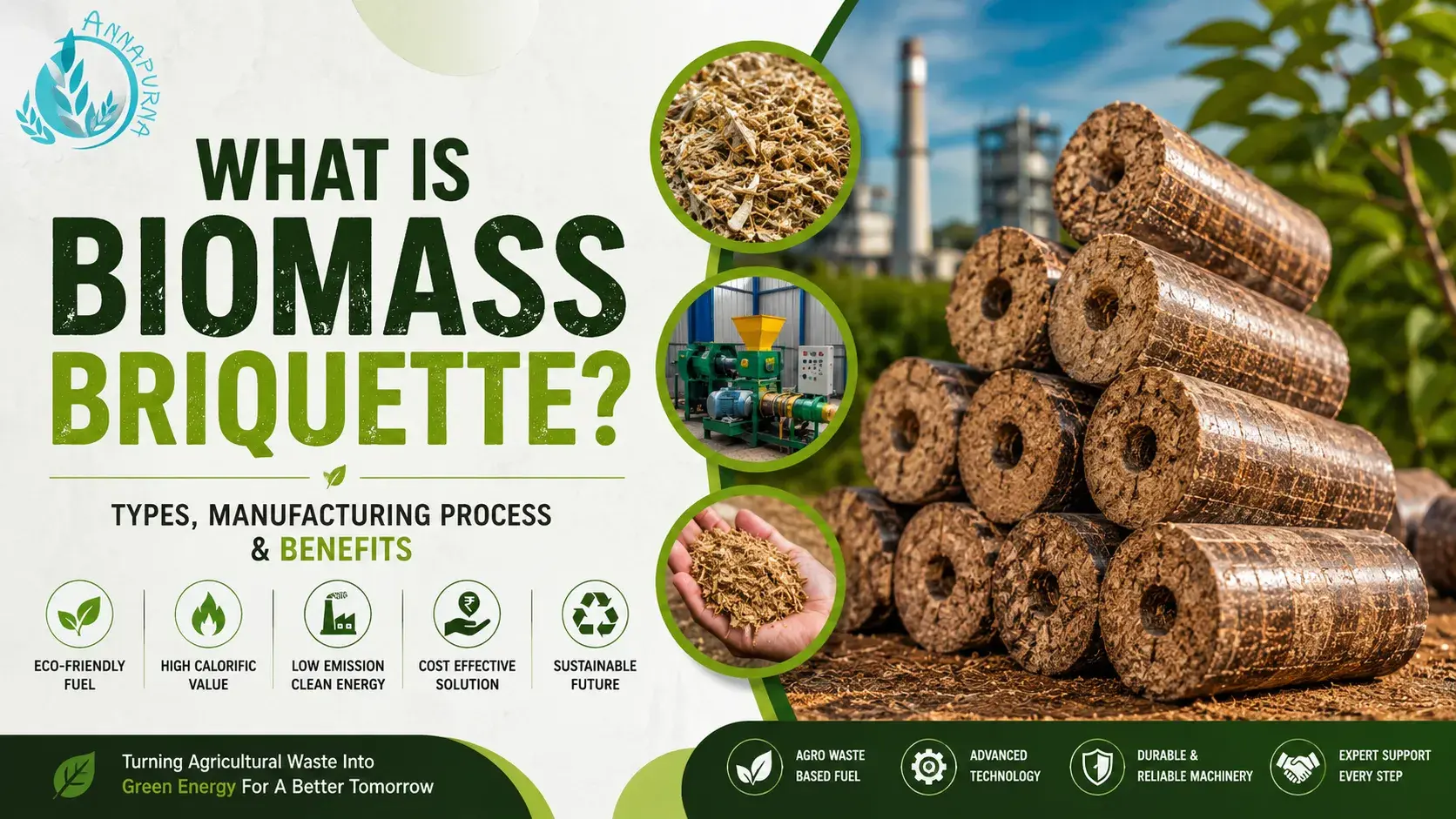
In this detailed guide, we’ll explain What is Biomass Briquette? Types, Manufacturing Process & Benefits, while also discussing biomass briquettes raw material, briquettes manufacturing, investment considerations, and the growing business opportunities in this renewable energy sector.
What is a Biomass Briquette?
A biomass briquette is a solid fuel produced by compressing agricultural waste, forestry residues, and other biodegradable materials under high pressure. Unlike loose biomass, which is difficult to handle and burns inefficiently, briquettes have a compact structure that makes them easier to store, transport, and use.
The unique feature of biomass briquettes is that they are manufactured without chemical binders. During compression, the natural lignin present in biomass softens and binds the particles together, creating dense and durable fuel blocks.
Because of their uniform size and low moisture content, biomass briquettes burn more efficiently than traditional firewood. They produce consistent heat, generate less smoke, and leave behind minimal ash, making them an excellent fuel choice for industries aiming to improve energy efficiency while reducing their carbon footprint.
Also Read: Why Grain Cleaning Is the First Step to High-Quality Rice Production
Why Are Industries Choosing Biomass Briquettes?
Industrial fuel selection is no longer based only on price. Companies today focus equally on efficiency, sustainability, and environmental compliance. This shift has significantly increased the demand for biomass briquettes.
Unlike coal, biomass is considered a renewable energy source because it is produced from agricultural residues that are naturally replenished every harvesting season. Instead of burning crop waste in open fields, farmers can convert it into valuable industrial fuel, creating additional income while reducing air pollution.
For industries, biomass briquettes provide a stable fuel source with better combustion efficiency and lower maintenance requirements. Their uniform density ensures consistent heat generation, which directly improves the performance of industrial boilers and furnaces. As governments continue to encourage the use of clean energy, biomass briquettes are becoming an important part of sustainable industrial operations.
Types of Biomass Briquettes
Biomass briquettes are available in different shapes and sizes to suit various industrial applications. The selection usually depends on the type of boiler, furnace, or combustion system being used.
Cylindrical briquettes are the most common because they provide excellent density and efficient burning. Industries using steam boilers generally prefer these briquettes due to their stable combustion characteristics.
Hexagonal briquettes feature a central hole that improves airflow during combustion. This design increases burning efficiency and reduces smoke generation, making them suitable for high-temperature industrial applications.
Square and rectangular briquettes are also used where handling and storage convenience are priorities.
Among all available sizes, the 90mm biomass briquette has become one of the most popular options for industrial heating systems. Its standard dimensions ensure smooth feeding into boilers and provide a consistent heat output, making it ideal for continuous industrial operations.
Biomass Briquettes Raw Material
The quality of biomass briquettes largely depends on the raw materials used during production. One of the biggest advantages of this industry is that it utilizes agricultural waste that would otherwise be discarded or burned.
Common biomass briquettes raw material includes rice husk, wheat straw, mustard stalk, cotton stalk, sugarcane bagasse, sawdust, groundnut shells, coconut shells, corn cobs, coffee husks, bamboo waste, and various forestry residues.
These materials contain natural lignin, which acts as a binding agent during compression. As a result, manufacturers can produce high-density briquettes without adding chemicals or adhesives.
The use of agricultural waste not only supports renewable energy production but also contributes to cleaner farming practices by reducing stubble burning and environmental pollution.
Briquettes Manufacturing Process
The briquettes manufacturing process involves several stages to ensure high-quality fuel production.
- Raw Material Collection: Agricultural and forestry residues are collected from farms, sawmills, and agro-processing industries.
- Drying: The moisture content is reduced to improve briquette density and combustion efficiency.
- Size Reduction: Large biomass materials are crushed into smaller particles for uniform processing.
- Compression: The processed material is compressed under high pressure in a briquetting machine, where natural lignin binds the particles together.
- Cooling & Storage: The finished briquettes are cooled before packaging and storage to maintain their strength and durability.
Modern briquetting technology ensures consistent density, low moisture content, and superior fuel quality.
Benefits of Biomass Briquettes
Industries are rapidly switching to biomass briquettes because they offer several economic and environmental advantages.
- Renewable and eco-friendly fuel source
- High calorific value with consistent heat generation
- Lower smoke and reduced carbon emissions
- Minimal ash production compared to coal
- Easy storage, handling, and transportation
- Efficient combustion with reduced fuel wastage
- Helps utilize agricultural waste productively
- Lowers dependence on conventional fossil fuels
- Reduces overall industrial fuel costs
- Supports sustainable manufacturing practices
Biomass Briquettes Manufacturing Plant Cost & Price
One of the most common questions among entrepreneurs is about the briquettes manufacturing plant cost. The investment required depends on several factors, including production capacity, automation level, machine quality, raw material handling equipment, drying systems, and overall plant configuration.
Similarly, the bio coal manufacturing plant cost varies according to the desired production output and the type of machinery selected. While small-scale plants require a comparatively lower investment, fully automated commercial plants involve higher capital costs but offer greater production efficiency and long-term profitability.
Another important consideration is the biomass briquettes price, which depends on raw material availability, moisture content, calorific value, density, transportation expenses, and regional demand. High-quality briquettes may cost slightly more, but they provide better combustion efficiency, lower ash generation, and reduced fuel consumption, making them more economical in the long run.
Applications of Agro Waste Biomass Briquettes
The increasing demand for agro waste biomass briquettes demonstrates how agricultural residues can be transformed into valuable industrial fuel. These briquettes are now widely used across multiple industries because they provide reliable thermal energy while supporting sustainable manufacturing practices.
Industries such as textiles, food processing, paper mills, pharmaceuticals, chemicals, ceramics, dairy plants, rice mills, brick kilns, and commercial heating facilities commonly use biomass briquettes in boilers and furnaces. Their uniform burning characteristics help maintain stable temperatures, improve equipment efficiency, and reduce fuel-related operational costs.
Apart from industrial applications, agro waste biomass briquettes also contribute to cleaner waste management by converting crop residues into renewable energy instead of allowing them to be burned in open fields.
Why Choose Annapurna Agronics Machinery Pvt. Ltd.?
Producing premium-quality biomass briquettes requires reliable and efficient briquetting equipment. Choosing the right machine directly affects production capacity, briquette density, operating costs, and long-term profitability.
Annapurna Agronics Machinery Pvt. Ltd. is a trusted Biomass Briquette Machine Manufacturer and Supplier in India, offering advanced briquetting solutions for entrepreneurs, industries, and renewable energy projects. Our machines are designed to process a wide variety of agricultural and forestry residues into high-density biomass briquettes with excellent combustion performance.
Manufactured using robust components and advanced engineering, our biomass briquette machines are known for their high production efficiency, low power consumption, easy operation, and long service life. Whether you are planning a new briquetting unit or expanding an existing business, our experienced team provides customized machinery, technical guidance, installation support, and dependable after-sales service to ensure long-term success.
Conclusion
Biomass briquettes are transforming the way industries generate heat by providing a renewable, economical, and environmentally responsible alternative to coal and firewood. Manufactured from agricultural waste, they offer excellent calorific value, cleaner combustion, and lower emissions while helping industries reduce fuel costs and improve operational efficiency.
As demand for sustainable energy continues to grow, biomass briquettes are becoming an essential part of modern industrial heating systems. Investing in advanced briquetting technology not only supports cleaner production but also creates profitable business opportunities in the renewable energy sector.
If you are looking for high-performance Biomass Briquette Machines, Annapurna Agronics Machinery Pvt. Ltd. offers reliable and innovative solutions designed to maximize productivity, ensure consistent briquette quality, and support your journey toward sustainable fuel production.