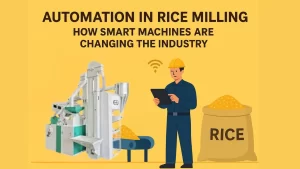

Rice is a staple of the Indian diet, and the country’s agricultural economy depends on its yield and quality. In modern times, the rice milling process has played a crucial role in improving rice quality, reducing losses, and increasing production efficiency. In this blog, we will explain the meaning of rice milling, the rice mill process, and all its steps in simple terms.
Meaning of Modern Rice Milling Process
Modern Rice Milling Process means – an advanced and scientific process of extracting rice from paddy. In this, clean, shiny and edible rice is prepared by removing the top layer (husk), husk and impurities of paddy. In old times, milling of rice was done by hand or with simple tools. But in today’s modern rice mills, this work is done in a fast, easy and accurate way with the help of machines.
Milling of Rice Meaning: Milling of rice means removing husk, silica, and unnecessary layers from raw paddy to produce edible white rice. In Hindi, it is the process of converting paddy into rice. This process involves cleaning, husking, and polishing the rice.
Also Read : Automatic Dal Mill Machine vs Traditional Milling: Which is Better?
Difference Between Rice and Paddy
It is important to understand the difference between rice and paddy.
- Paddy: Paddy obtained directly from the field, with the husk and outer layer still attached.
- Rice: The finished product after the milling process, used for cooking and sale.
Thus, only after milling the paddy do we obtain edible rice.
Modern Rice Milling Process
The modern rice milling process involves several steps that improve both the processing and quality of the rice. This process is carried out on a large scale in paddy rice mills.
Rice Milling Process – Step by Step
- Cleaning of Paddy: This involves removing stones, dust, sand, and other impurities from the paddy. This is the first and most important step.
- Husking / De-husking: This stage marks the beginning of the milling of rice. The husking machine removes the outer husk from the paddy and produces brown rice.
- Paddy Separation: After husking, the machine separates the brown rice and the husk. This is the second important part of the rice processing steps.
- Polishing / Whitening: Brown rice is passed through a polishing machine, which gives it a shiny and attractive appearance. This is considered a key part of the rice milling process.
- Grading / Sorting: Rice is separated according to size and quality. Small, broken, or low-quality rice is removed.
- Blending: Different grades of rice are mixed to produce a product of uniform quality.
- Packaging: Finally, the processing rice is packaged to ensure its long-term preservation.
Stages of Rice Processing (From Paddy to Rice)
- Paddy Reception – Arrival of Paddy
- Cleaning – Cleaning
- De-husking – Removing the Husk
- Paddy Separation – Separation of Paddy and Brown Rice
- Whitening/Polishing – Polishing
- Grading/Sorting – Classification by Quality
- Blending – Blending
- Packaging – Packing
All these stages together constitute the modern rice milling process.
Modern Rice Milling Process Flow Chart
A Simple Flow Chart of Modern Rice Milling Process is given below:
धान (Paddy) → Cleaning → Husking → Paddy Separation → Whitening/Polishing → Grading → Sorting → Packaging → तैयार चावल (Rice)
This flow chart shows how systematic and scientific the entire rice processing process is, from paddy to edible rice.
Advantages of Modern Rice Milling Process
- High-quality rice is obtained.
- Rice mills increase production efficiency.
- Food waste is reduced.
- Stages of rice processing reduce losses.
- Rice improves its shine and cleanliness in the market.
Role of Paddy Rice Mill in Processing of Rice
Paddy rice mills simplify and speed up rice processing steps by using modern equipment and machinery. These machines combine paddy cleaning, husking, polishing, and packing. This modern method of rice milling is beneficial for both farmers and traders.
Milling of Rice and Indian Economy
India is the largest rice producing country in the world. Milling of rice not only increases the income of farmers but also brings foreign exchange through export. Adoption of modern rice milling process strengthens India’s Rice Industry.
Conclusion
Today, modern rice milling processes have improved rice quality and yield compared to traditional methods. Only after milling of paddy do we obtain white, shiny, and high-quality rice. If you are looking to expand your paddy rice mill or rice processing business, the modern machinery and technology from Annapurna Agronics Machinery Pvt. Ltd. will help you ensure improved production and quality.