In order to process rice efficiently and make sure that the rice obtained is of the best quality, there is a need for a series of machines to be used. Out of all the machines available in the rice milling process, the paddy separator machine stands out in importance. This is due to the fact that without separating the paddy from brown rice, the milling process may not be efficient at all.
In modern rice processing plants, the paddy separator is considered one of the most important machines because it helps achieve accurate separation after the dehusking process. Whether you operate a small rice mill or a large commercial paddy rice mill, understanding the working principle and benefits of a paddy separator can help you optimize your milling operations.
In this article, we will explore what a paddy separator machine is, how it works, its key components, benefits, applications, and factors to consider when selecting the right machine for your rice processing plant.
What is a Paddy Rice Separator Machine?
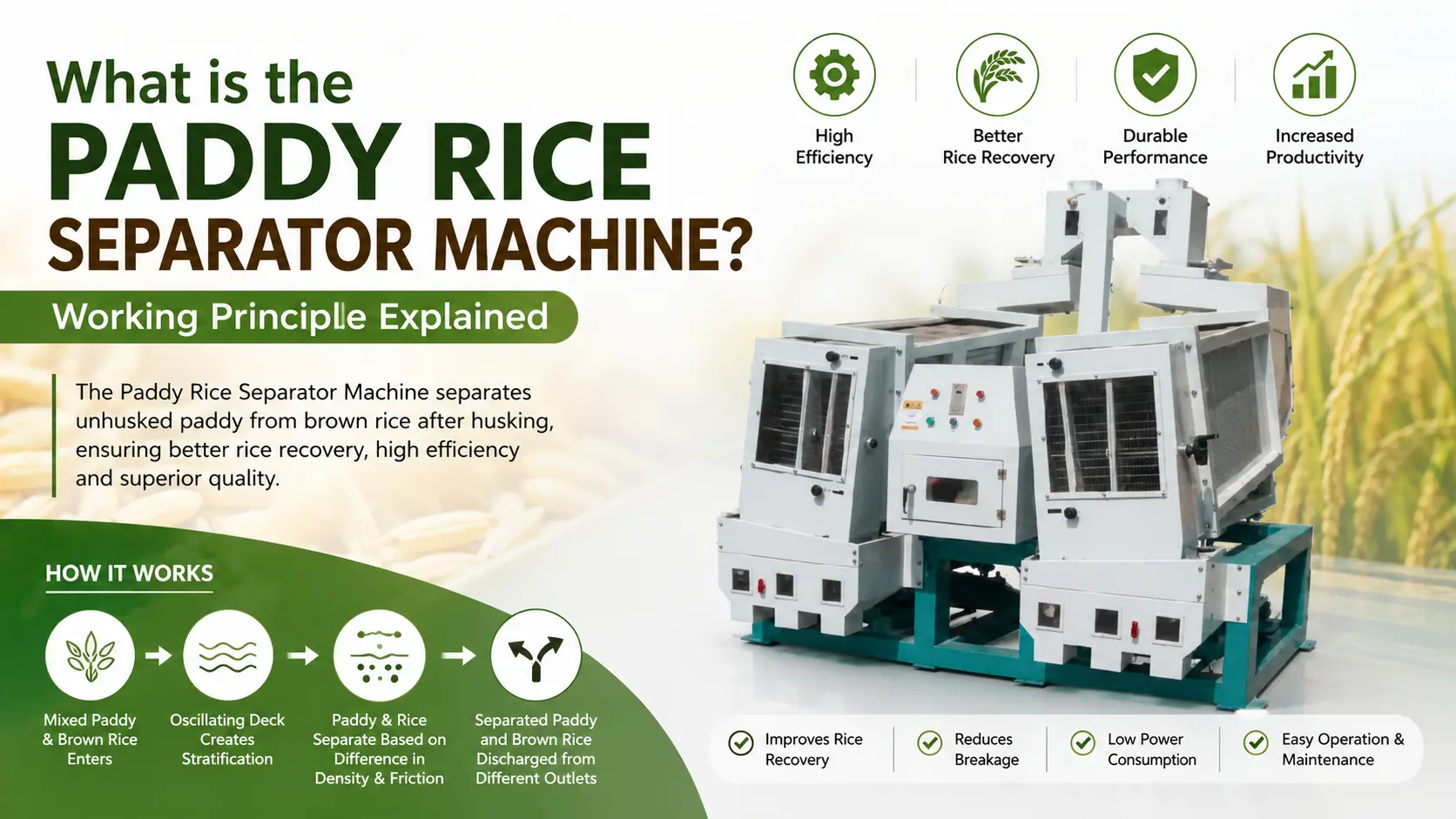
A paddy separator machine is a specialized equipment used in rice mills to separate unhusked paddy grains from brown rice after the husking process. During dehusking, not all paddy grains are completely husked. As a result, the output contains a mixture of brown rice and unhusked paddy.
The primary function of the rice separator machine is to separate these two materials efficiently so that brown rice can proceed to the whitening and polishing stages, while unhusked paddy is sent back for reprocessing.
The separation process significantly improves rice recovery, reduces wastage, and enhances the overall efficiency of a paddy rice mill.
Also read Rice Husk Grinding Machine
Why is Paddy Separation Important?
The dehusking process rarely achieves 100% husk removal. Typically, the mixture leaving the husker contains:
- Brown rice
- Unhusked paddy
- Small impurities
If this mixture is sent directly to polishing machines, the remaining paddy can damage equipment and reduce the quality of the final rice.
A paddy separator ensures that only properly husked rice moves forward in the production line. This improves milling performance and helps maintain premium rice quality.
Working Principle of a Paddy Separator Machine
The working principle of a paddy separator machine is based on the difference in physical characteristics between brown rice and unhusked paddy.
Although both grains are similar in size, they differ in:
- Surface texture
- Density
- Friction coefficient
- Shape characteristics
The separator uses these differences to achieve effective separation.
Step 1: Feeding the Mixture
The mixture of brown rice and paddy enters the separator through a feeding mechanism. The feed is evenly distributed across the separator deck.
Step 2: Oscillating Movement
The separator deck performs a controlled oscillating motion. This movement causes the grains to move across the surface.
Step 3: Stratification Process
Due to differences in friction and density, brown rice and paddy begin to separate naturally.
- Brown rice tends to move in one direction.
- Unhusked paddy moves in another direction.
This phenomenon is known as stratification.
Step 4: Separation
The machine separates the grains into different outlets.
Typically, the outputs include:
- Pure brown rice
- Mixed grains
- Unhusked paddy
The mixed grains may be returned for further separation, while the unhusked paddy is sent back to the husker.
Step 5: Continuous Operation
Modern rice separator machines operate continuously, ensuring a steady flow of material and uninterrupted production.
Main Components of a Paddy Separator Machine
A modern paddy rice machine consists of several essential components.
Feed Hopper
The feed hopper receives the mixture from the husker and ensures uniform distribution.
Separator Deck
The separator deck is the heart of the machine. It provides the surface where grain separation takes place.
Oscillation Mechanism
This system generates the controlled motion required for stratification and separation.
Collection Channels
Separate outlets collect brown rice, paddy, and mixed grains.
Frame Structure
The robust frame supports the machine and ensures stable operation.
Benefits of Using a Paddy Separator Machine
Improved Rice Recovery
One of the biggest advantages of a paddy separator machine is its ability to maximize rice recovery.
By effectively separating unhusked grains, the machine reduces losses and increases profitability.
Better Rice Quality
The separator ensures that only properly husked rice proceeds to the next processing stage, resulting in better-quality finished rice.
Reduced Grain Breakage
Proper separation reduces stress on downstream equipment, helping minimize grain damage and breakage.
Higher Milling Efficiency
A paddy separator improves the overall efficiency of rice processing operations by ensuring smooth workflow and reducing reprocessing requirements.
Lower Operational Costs
Efficient separation minimizes wastage and helps optimize machine performance, leading to reduced operating costs.
Consistent Output
Modern separators provide reliable and consistent performance even during continuous production.
Applications of Paddy Separator Machines
A paddy separator machine is widely used in various rice processing facilities.
- Commercial Rice Mills- Large-scale rice mills use separators to maintain high production efficiency.
- Modern Paddy Rice Mills- Integrated paddy rice mill plants depend on separators to achieve premium rice quality and higher recovery rates.
- Rice Processing Plants- Rice processing facilities utilize separators as a critical part of the milling line.
- Export-Oriented Rice Production Units- Export-quality rice requires precise processing. A rice separator machine helps achieve the consistency demanded by international markets.
Factors to Consider When Buying a Paddy Separator Machine
Selecting the right machine is essential for long-term performance and profitability.
- Capacity Requirements- Choose a machine that matches your production volume and future expansion plans.
- Separation Efficiency- Look for equipment with high separation accuracy to maximize rice recovery.
- Build Quality- Durable construction ensures reliable operation and longer service life.
- Energy Consumption- Energy-efficient machines help reduce operating expenses.
- Maintenance Requirements- Select a machine that is easy to maintain and has readily available spare parts.
- Automation Features- Advanced automation can improve productivity and reduce labor dependency.
- Manufacturer Reputation- Always choose a trusted manufacturer with experience in rice milling technology and strong after-sales support.
How Paddy Separator Machines Improve Rice Mill Performance
The success of a rice milling operation depends heavily on maintaining product quality and minimizing losses. A paddy separator machine contributes directly to these goals by ensuring accurate grain separation.
Without a separator, unhusked paddy may enter polishing machines, leading to equipment wear, lower product quality, and reduced efficiency. By eliminating these issues, the separator helps mills achieve higher productivity and better profitability.
As rice demand continues to grow globally, investing in advanced paddy rice machine technology has become essential for modern milling operations.
Conclusion
A paddy separator machine is one of the most important machines in any modern paddy rice mill. It efficiently separates unhusked paddy from brown rice after the husking process, improving rice recovery, reducing wastage, and enhancing overall milling efficiency.
Understanding the working principle of a paddy separator, along with its benefits and applications, can help rice mill owners make informed investment decisions. Whether you are setting up a new rice processing plant or upgrading an existing facility, choosing a high-quality rice separator machine can significantly improve production performance and rice quality.
Annapurna Agronics Machinery Pvt. Ltd. provide advanced rice milling solutions designed to deliver superior efficiency, reliability, and long-term value for modern rice processing operations.